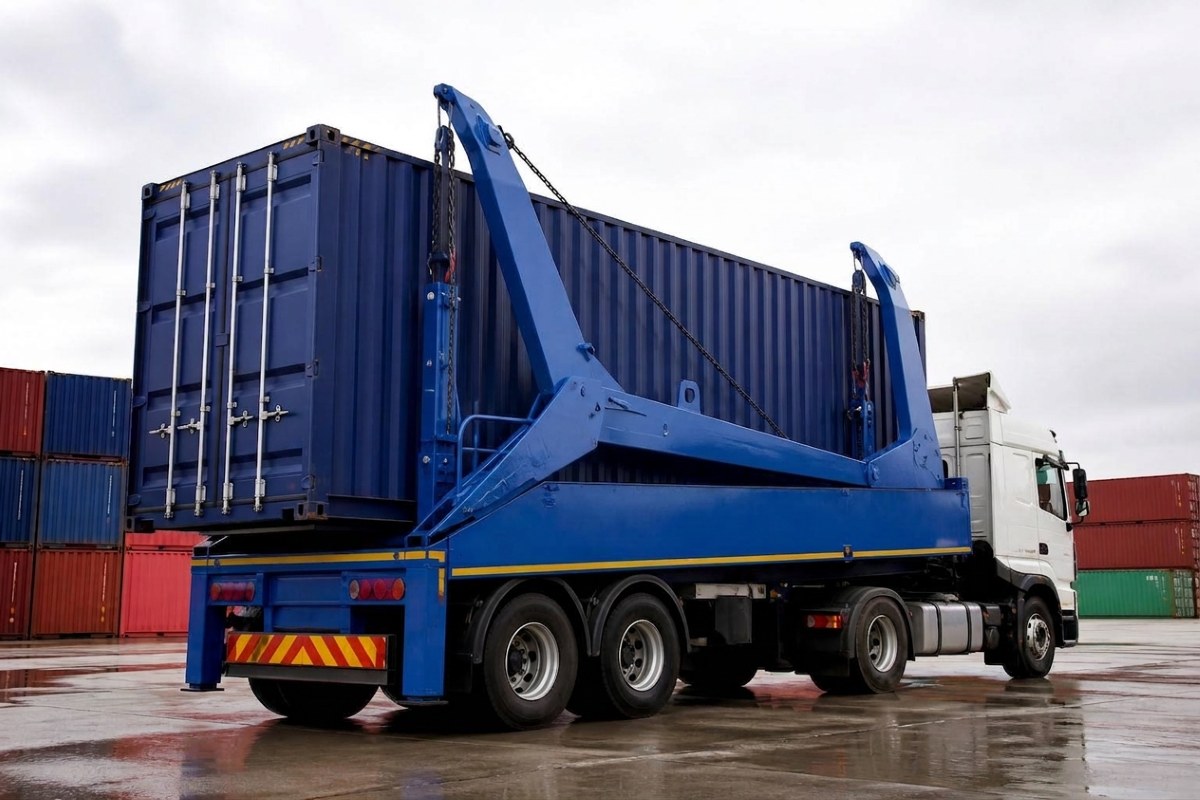

Side lifter container transport reduces equipment overhead for local Cape Town businesses by eliminating the need to purchase, hire, or maintain costly mobile cranes and heavy forklifts at loading sites. A self-loading side lifter trailer uses hydraulic cranes mounted directly on its chassis to lift, ground, and transfer loaded ISO containers independently. This single-vehicle solution replaces multi-vehicle operations, cuts site equipment rentals, minimises labour requirements, and speeds up turnaround times across industrial hubs like Epping, Paarden Eiland, Montague Gardens, and the Port of Cape Town.
Eliminating Capital Investment in Heavy Offloading Machinery
Purchasing heavy machinery purely to transfer shipping containers onto the ground creates massive capital expenditure that sits idle for most of the week. Renting a mobile crane or high-capacity forklift every time a container arrives at your depot drains operational budgets through hourly minimums and call-out fees. Side lifters solve this financial burden by incorporating the lifting mechanism directly into the delivery vehicle.
By shifting to self-loading transport, Cape Town import and export operations trim unnecessary equipment expenses across four distinct categories:
- Machinery capital expenditure: Eliminates the requirement to buy or lease dedicated reach stackers and industrial forklifts.
- Rigging and crane hire fees: Removes third-party crane mobilisation costs for temporary job sites and short-term storage yards.
- Ground preparation expenses: Replaces heavy equipment staging areas with simple flat surface requirements.
- Maintenance and servicing overheads: Transfers mechanical upkeep, hydraulic inspections, and certification costs entirely to the transport provider.
Streamlining Site Operations and Labour Expenses
Traditional container offloading requires a coordinated team of crane operators, riggers, and truck drivers working in sync. Scheduling these teams creates bottlenecks, particularly when delays occur at the Cape Town Container Terminal or along the N1 and N2 corridors. If a truck arrives late, mobile crane crews sit idle on billable hours.
Single-Operator Efficiency
A side lifter transport vehicle operates with a skilled driver who manages the entire hydraulic offloading process safely from a remote control unit. This removes the need for extra ground crew while maintaining strict safety standards. Businesses can explore side lifter transport services to see how single-operator execution simplifies container handling.
Operating with a single vehicle and operator delivers immediate practical benefits for local depots:
- Reduced headcount requirements: Drops site labour overhead down to zero additional workers per container drop.
- Eliminated idle wait charges: Removes billable standby hours for external crane operators delayed by port congestion.
- Faster operational cycles: Completes container grounding or trailer-to-trailer transfers in under ten minutes.
- Optimised footprint usage: Allows container placement in tight industrial bays where large cranes cannot operate.
Flexibility During Regional Power Disruptions
Load-shedding and localised electrical outages frequently impact warehouse gantries and electric loading equipment in Western Cape industrial zones. Because side lifters operate on independent hydraulic systems powered directly by the truck engine, loading and offloading continue without interruption during power grid outages.
Maximising Yard Space and Container Turnaround
Leaving containers mounted on road trailers while waiting for unpacking causes expensive trailer detention fees and ties up valuable parking space. Side lifters place shipping containers flat on the ground, allowing your team to pack or unpack at ground level safely using standard pallet jacks.
Grounding containers efficiently provides key operational advantages for Cape Town warehouses:
- Zero trailer detention penalties: Offloads containers onto the floor immediately so trucks can return to service.
- Ground-level loading safety: Eliminates high-risk ramp loading and reduces worker injury risks.
- Dense yard stacking: Places containers double-stacked or side-by-side in narrow lanes to maximise spatial capacity.
Side Lifter Container Transport With RRE Logistics
Managing equipment overhead requires smart, direct transport choices that keep your capital working effectively. RRE Logistics provides specialised container handling solutions designed to keep Cape Town freight moving smoothly without expensive site machinery. Direct your team to reach out by clicking the button below for a fast, accurate transport quote aligned with your local schedule.
FAQs
How much weight can a side lifter lift?
Standard side lifter units comfortably lift up to 36 tonnes, making them capable of handling fully loaded 20-foot and 40-foot ISO shipping containers without external assistance.
Can a side lifter place containers directly onto another trailer?
Yes. Side lifters perform trailer-to-trailer and trailer-to-rail transfers, enabling quick transshipment without needing staging cranes in transit yards.
What space is required for a side lifter to operate in a Cape Town facility?
A side lifter requires parallel alignment alongside the target drop zone and roughly four metres of lateral clearance on one side to extend its stabilising legs and hydraulic crane arms.
How does container grounding lower long-distance freight costs?
Grounding containers allows transport trucks to depart immediately for the next run rather than sitting on-site during packing or unpacking, maximising vehicle utilisation and avoiding expensive detention surcharges.